Routing Every Agent in Your Delivery Stack Through a Single Brand Context Service
A shared context service keeps every agent on current brand rules.
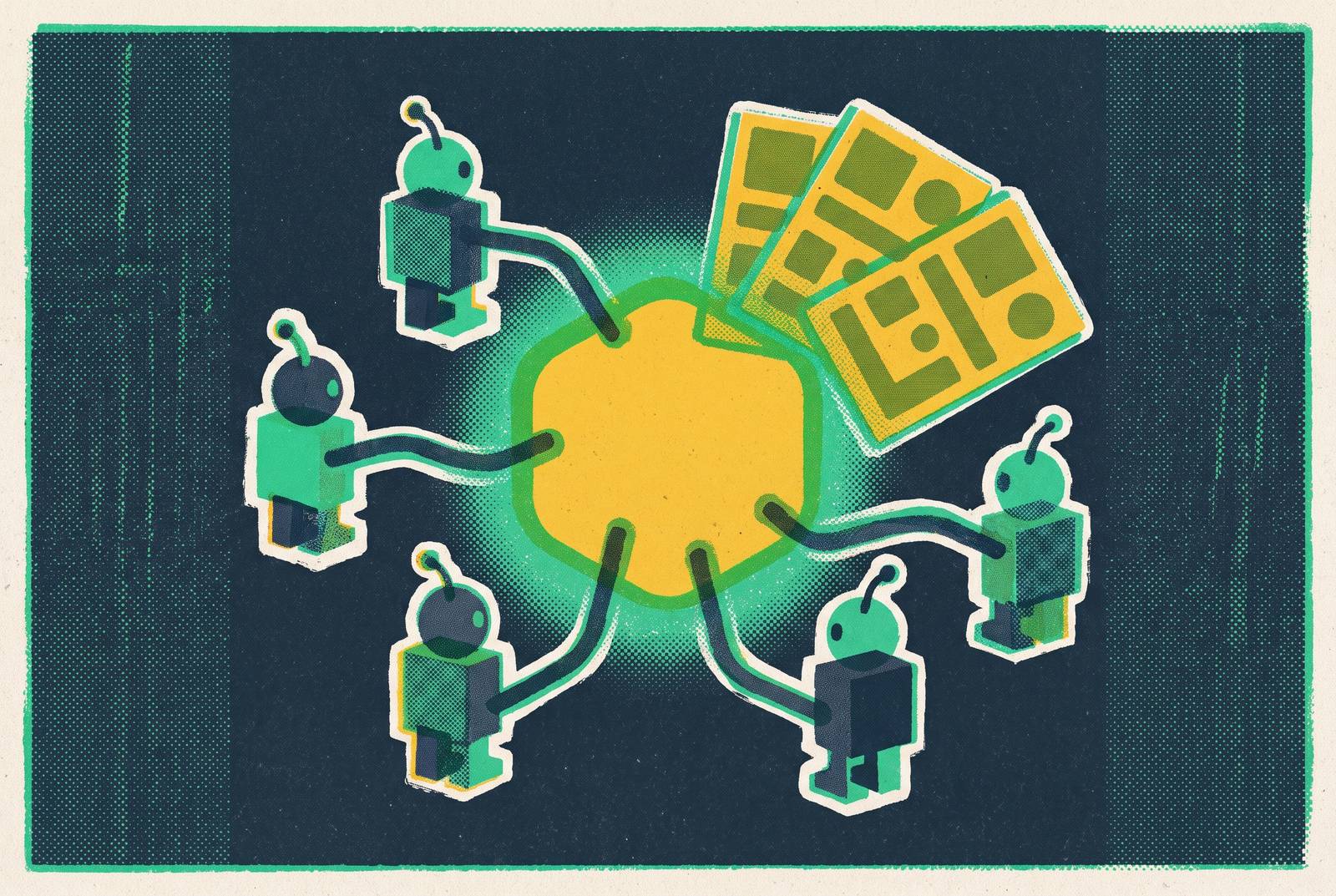
A brand context layer for AI agents and products is a shared, machine-readable service that every agent queries before creating or evaluating work. Routing the delivery stack through that service turns brand consistency from a per-agent maintenance burden into a governed infrastructure function. The architecture works when context is explicit, versioned, scoped to the right brand, and available wherever an agent acts.
Why per-agent brand maintenance breaks down at delivery-stack scale
A team updates four agents with new brand guidance, then discovers that a fifth needs the same change. The update is not finished after all. A creation agent, a formatting agent, a channel-adaptation agent, and a validation agent each depend on brand rules, but their separate copies create separate maintenance obligations.
Outdated templates, external partners working from old PDF guides, and rushed adaptations to platform requirements already create opportunities for drift. Agent handoffs amplify those weaknesses when each stage interprets a different copy of the guidance. Copy-pasting brand guidelines into “mega-prompts” reproduced that fragmentation while running into context-window limits and creating security risks.
What a shared brand context service actually contains
A shared service replaces those copies with machine-readable context that agents can query at runtime. It is not simply a digitized brand book. A brand book assumes a human reader who can interpret examples, resolve ambiguity, and apply judgment. A context service needs explicit rules and structured references that a machine can apply to a particular task without someone translating the guidance first.
Three layers give the service its substance. The Voice Profile sets out the tone descriptors, words to favor, rules for sentence structure, and banned phrases. The Body of Work provides annotated examples of on-brand output, showing how those rules work in practice. Design Tokens express colors, typography, spacing, and border radii as structured JSON. Semantic names such as color.action.primary describe a value’s purpose, so an agent references the intended role rather than treating a raw hex code as the entire instruction.
A token file retrieved at query time gives the agent a more reliable reference for exact colors than values embedded in a prompt. Sitecore’s approach, shipped in August 2026, illustrates the broader production form of structured context. Organization admins and owners provide a brand website URL, and the system generates editable Markdown files covering company information, products and services, audiences, messaging, content guidelines, and customer evidence.
Loni Stark, VP of Strategy and Product at Adobe, described the shift in Adobe’s April 2026 platform announcement at Adobe Summit 2026. “For decades, brands have managed content, but now they also need to manage context to pinpoint what AI understands about their offerings and the institutional knowledge their own agents need to act”.
How MCP makes every agent in the stack a first-class consumer of that context
Model Context Protocol, or MCP, supplies the common connection between agents and the service. Anthropic introduced MCP in November 2024, and OpenAI, Google DeepMind, and Microsoft have since adopted it natively. Its integration model cuts the number of custom connections from N×M to N+M implementations. Each agent and each context service implements the protocol once, which removes the need for a separate connection for every pairing.
The protocol exposes context in three complementary forms. Resources provide read-only structured data, including voice guidelines, product information, and audience definitions. Tools give agents callable functions, such as brand lookup, logo URL retrieval, and token retrieval by semantic name. Prompts supply templated instructions for interpreting and applying context to a specific task. Together, these forms distinguish the underlying brand knowledge from the operations and instructions used to apply it.
Brandfetch demonstrates how multiple clients consume one service. Its Brand Context API accepts a domain and returns a structured, narrative-rich profile covering identity, positioning, voice, and visual style. Its MCP server exposes brand lookup, logo URLs, and search to Claude, Cursor, Windsurf, Gemini CLI, and other compatible clients. The practical gain is a reusable interface. A new compatible agent becomes a context consumer when it connects, rather than starting another bespoke brand integration project.
How routing works inside a multi-agent delivery pipeline
A brief enters the stack and reaches a creation agent. Before generating anything, that agent queries the shared service for the voice profile, relevant design tokens, and guidance for the requested output type. An email and a campaign image need different parts of that context. The agent then generates from the retrieved guidance.
The next handoff preserves the same governing reference. A validation agent queries the service and checks the draft against the applicable rules, producing a pass or fail with evidence for each check. A “Brand Guardian Agent” can return a draft for rewriting when it contains a banned phrase or breaks the required tone. Only assets that clear the automated checks proceed to human review. Designers can then focus on creative quality without checking exact color values over and over.
Visual generation follows the same sequence of retrieval and application. An agent producing a campaign image reads color.action.primary from the token file at runtime. Post-generation correction to official hex codes remains a fallback for achieving compliance. Adobe’s Experience Manager illustrates the division of labor through its Brand Experience Agent, Content Advisor Agent, and Brand Governance Agent. The first creates and updates content, the second finds approved content, and the third enforces policies while tracking asset rights and managing permissions.
The service is therefore not another sequential production stage. It is a shared dependency called by the agents that need it, much as a microservice calls a configuration store or secrets manager. This distinction explains how routing prevents drift at handoffs. The output changes hands, but the rules do not have to be copied, summarized, or reinterpreted into another agent’s private instructions.
Why brand context must be versioned and propagated, not frozen
If a service retains outdated rules after the brand changes, it distributes the same error throughout the stack. Uniformity can conceal the problem because agents may agree with one another while disagreeing with the current brand. Centralization therefore increases the importance of maintaining the source.
Version control makes that maintenance traceable through templates and context files that record who changed what, when the change occurred, and what was rolled back. Propagation makes the approved change operational, so future assets use updated tokens and guidance without edits to individual agents. Storage is only half the requirement.
For brand managers, this means an update should not trigger tickets to every team operating an agent. The update belongs in the shared service, with a process that reaches every dependent workflow. Quantitative brand consistency metrics then help teams detect drift before it accumulates and relate problems to the governing context. Versioning gives teams the history they need to look into those problems, while measurement shows where more fixes are needed.
Is centralized brand context worth it when an agency scales beyond five clients?
The number of clients is not the architectural test. Centralization becomes useful when separate brand updates and repeated workflow handoffs make isolated copies difficult to govern. For an agency serving more than five clients, the relevant criteria are brand separation, scoped access, traceable changes, and approval workflows.
Each query must name the brand it is serving. System prompts, tone configuration, policy rules, and data scope must differ by brand, while the underlying model can remain shared. Customer data, conversation history, and agent behavior for one brand must stay out of another brand’s experience. Brand identifiers make the routing explicit. Separate names and color schemes layered onto a shared agent are not sufficient boundaries.
At portfolio scale, a token graph and federated control plane can coordinate token lifecycles, visual rules, and release pipelines across brands, regions, and platforms. Shared design semantics provide a common structure without forcing every brand to use the same values or voice. Brands share the protocol and infrastructure, but each keeps its own context. This makes separation a property of the architecture rather than a dependence on separate agent deployments.
Approval depth also needs to reflect the work. Automated checks can precede peer review for standard assets and senior review for flagship work. That tiered model supports higher volume without requiring every asset to receive the same level of human attention. When choosing software, teams should weigh context retrieval, policy enforcement, and portfolio governance as separate needs, since products that expose brand information are not all interchangeable.
The legitimate objection: centralization creates a single point of failure
If the context service is unavailable, every agent that depends on it faces the same interruption. If its access controls are weak, the consequences can extend across connected workflows. Standardizing the connection does not remove either concern, and protocol compatibility is not evidence that an implementation is secure.
Stacklok’s State of Model Context Protocol in Software 2026 found that 64% of respondents named security concerns as the top obstacle to MCP adoption. The report drew on a December 2025 survey of 300 senior technical leaders across software, financial services, and retail, with 100 from each industry. MCP’s own security guidance identifies “confused deputy” risks in proxy servers. These arise when an intermediary’s authority can be exploited, including where static client identification lacks per-client consent controls.
The U.S. National Security Agency’s May 2026 statement said gaps in MCP design, implementation, and operational posture were serious security concerns that were still changing. Those concerns cannot be dismissed as resistance to change. The July 2026 specification revision introduced a stateless protocol core and authorization hardening, including OAuth 2.1 issuer validation and a shift away from Dynamic Client Registration. It did not make audit logging or fine-grained permissions automatic properties of a deployment.
Fragmentation leaves many smaller attack surfaces and stale copies, while centralization concentrates the dependency but makes its rules and access governable from one place. The recommended approach is shared infrastructure with access controls, audit logs, permission scoping per agent, and a defined update process. Those controls make centralization a defensible trade-off with continuing availability risks.
What the routing architecture means for how teams structure brand ownership
The organizational recommendation is to give the context service a named owner. Brand managers should set standards, maintain the context, and define when work requires human judgment. Creative quality and difficult exceptions still need people, while repeatable rule checks belong in the delivery system.
That division requires explicit mapping of the workflow. Teams need to establish who commissions a task, which agent performs it, who reviews and approves the output, and what happens when the result is weak or off-brand. Centralized, auditable rules make those handoffs definable. Governance should be part of the stack’s design from the beginning, with brand consistency scores and consumer engagement metrics tracked from day one, before drift becomes visible.
For agencies, the same ownership model changes the client relationship. Each client’s context lives in the service, so an approved brand change reaches the workflows using that context without re-briefing individual agents or re-training individual tools. The agency’s responsibility becomes maintaining an accurate, governed representation of the client’s brand and defining the human decisions around it. Brand ownership then has a clear remit, with authority over the standards, accountability for their upkeep, and an explicit place in the delivery organization.