AI Agent Handoffs in Agency Delivery Pipelines
Handoffs between specialized agents degrade brand context at every step.
Advertisement
Agency delivery pipelines are changing shape. What used to be a sequential human workflow with an AI tool bolted on at the edges is becoming a system of specialized agents, each one responsible for a discrete stage of production. The architectural difference matters: a single AI tool returns an output on request and the interaction ends there, but a multi-agent pipeline has one agent researching and briefing, another drafting, another optimizing for search, another routing work for approval, another tracking performance after launch. Each agent in that chain is a specialist, and every point where work passes from one to the next is a handoff. Agencies feel this most acutely because they run many clients at once, each with its own brand requirements, and a trained agent can be cloned and adapted across accounts in a way that scales output without scaling headcount. The platforms built around this model treat the pipeline as a coordination problem rather than a tooling problem, assigning specialized agents to customer experience, employee experience, search, content, and operations, all managed through a single control plane. These systems are built to understand context, make decisions across connected systems, and adapt when something falls outside the expected path, handling an entire campaign or procurement lifecycle, which is what separates them from older robotic process automation and point solutions.
Where multi-agent pipelines break at the handoff
The dominant failure mode in multi-agent pipelines isn't a single agent making a bad call. Failure concentrates at the seams, in the moment context passes from one agent to the next. Each handoff compresses information: the receiving agent works from a summary or a passed context object, not from the full history of decisions and constraints the upstream agent was holding. Researchers have given this a formal name, coordination drift, and they describe it as a breakdown in multi-agent consensus mechanisms; a router agent's bias toward certain sub-agents is one documented manifestation. Over time, a router's sense of which specialist to call becomes less precise, specialists receive context that has been garbled by successive compressions, and the shared understanding of the task erodes even though each agent, tested alone, still performs adequately. The customer-facing version of this failure is easy to observe and easy to measure: an AI system escalates to a human without surfacing the conversation summary, the customer's stated problem, or the steps already attempted, and the customer has to repeat everything from the start. CSAT scores drop precisely at that handoff point. Enterprise deployments report the same pattern at the infrastructure level: brittle handoffs occur between CRM and telephony systems, behavior grows harder to predict as an agent's scope expands, and hallucinated answers appear in regulated conversations where accuracy carries legal weight. Building a single prototype agent is comparatively straightforward. Running many agents reliably and under governance in production is where most teams stall, constrained by inconsistent agent behavior, weak governance structures, and the difficulty of scaling coordination across real business systems and demo environments alike.
Why brand context degrades at every transition
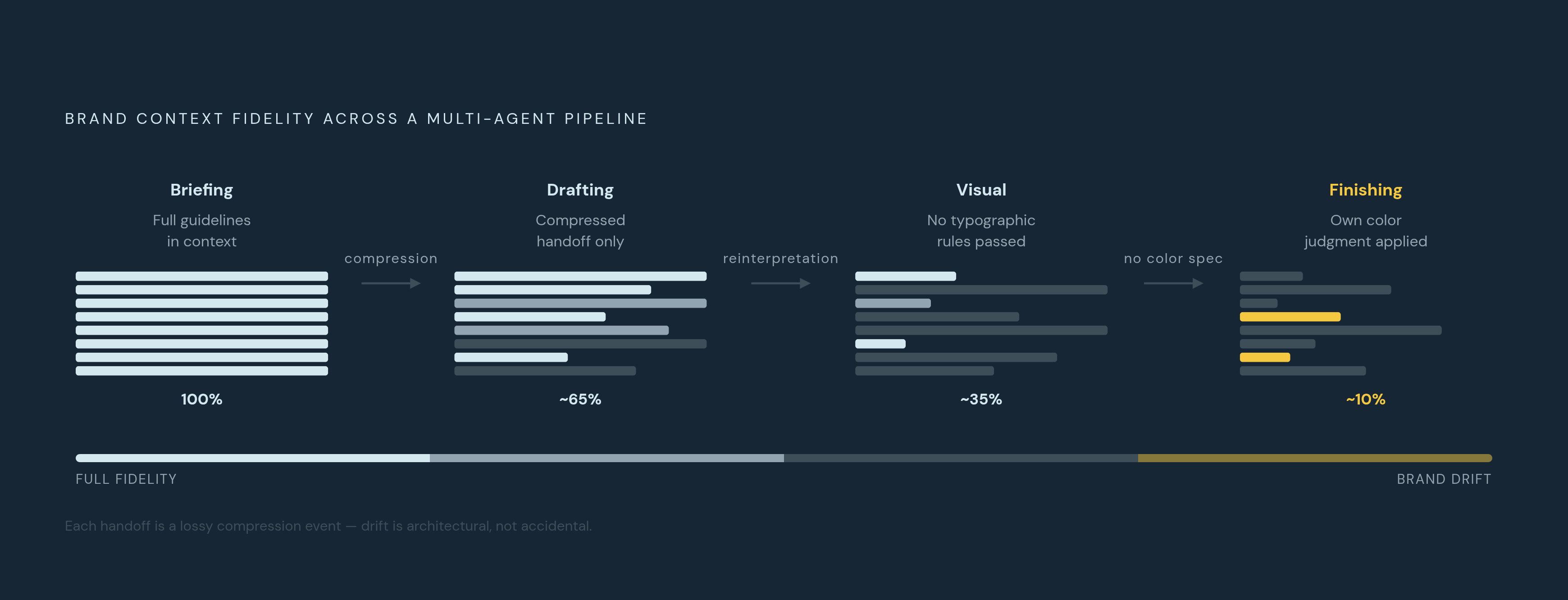
Brand identity is the most fragile piece of context moving through a multi-agent chain, because it was built for human interpretation, not for machine handoffs. Brand standards were designed for human designers and writers to read, interpret, and apply with judgment, taking the form of PDFs, mood boards, narrative tone-of-voice guidelines, and Figma files. An agent has no reliable way to retrieve and apply those documents at each stage of a pipeline, so it ends up doing one of three things: ignoring the guidelines, re-interpreting them from a compressed prose summary, or hallucinating compliance it hasn't actually achieved. The failure compounds as work moves down the chain. A briefing agent might have the full guidelines in its context window. The drafting agent that follows receives only a compressed handoff and reinterprets voice from that compression. The visual agent downstream has no connection at all to the typographic rules the brand depends on, and the finishing agent applies its own judgment about color because nothing more precise was passed to it. Each step introduces a small, incremental drift. Researchers studying this dynamic have named it agentic brand drift: as autonomous systems take over pricing, content, personalization, and supply chain decisions, the human choices that historically built brand identity are progressively displaced, and intended brand identity diverges gradually from the brand character the AI-orchestrated pipeline actually produces. What makes this form of drift distinctive is where it comes from. The origin is internal and architectural, produced by an organization's own AI systems working exactly as designed, rather than by external pressure, poor execution, or a deliberate change in strategy. On the visual side of agency work, you can't miss this failure. Consistency in a generative model's latent space is probabilistic by nature, so even a small variation in a prompt, or a quiet update to model weights somewhere upstream, can produce an asset that a brand director flags on sight as wrong. Across a 50-asset campaign, that kind of style creep accumulates quietly until the whole batch fails a client review.
What "structured for machine consumption" means for brand identity
Making brand context survive a multi-agent pipeline means translating it out of human-readable assets and into structured, retrievable artifacts that any agent can ingest without ambiguity at every stage. Practitioners converging on this problem describe the same shift from several directions: design tokens replace color guidelines, component libraries replace screenshots, structured content models replace Word documents, and explicit rules replace the tribal knowledge that used to live in a creative director's head. Brand identity, under this model, becomes a set of named, reusable decisions, like "brand primary" or "default spacing," rather than a hex value someone typed into a document by hand. On the visual side, the key artifact is the design token, expressed in JSON or YAML. An agent gets an exact value from a token instead of a prose description, so hallucination in generated output drops and visual work conforms to the brand. A design system that lives only as a Figma file and a Storybook gallery, with no structured token export and no machine-readable specification, is not something an agent can read reliably, no matter how well-organized it looks to a human. Voice and copy need the same treatment in a different form. A well-structured voice profile tells an agent how the brand speaks. A curated body of past work gives it proof of how the brand actually sounds in practice. A positioning document anchors both, and all three need to be formatted for a model to ingest, not simply for a person to read during onboarding. Agencies working through this problem sometimes bring these pieces together into a single compound artifact, occasionally called a brand context folder or a brand intelligence file: a structured Markdown file or an MCP link holding strategy, voice, and visual rules in a form a language model can parse without guessing. Every new agent session inherits that file rather than reconstructing brand understanding from scratch. The structural property that makes this durable is versioning. Brand identity needs to be updated the way code is updated, under version control, so that every downstream agent in the pipeline automatically inherits the latest specification instead of working from a stale copy nobody remembered to update. This matters most at three points in a pipeline: the design stage, where the visual language and system get defined; the shared building blocks stage, where components and tokens live; and the quality gate stage, where consistency gets checked. Catching token drift at that gate, before an asset reaches production, costs far less than explaining the same drift to a client after delivery.
Shared brand context through MCP
Model Context Protocol is the connective layer that makes it possible for every agent in a pipeline to pull from one versioned brand context instead of working from isolated, siloed copies of it. MCP is an open standard, now under the Agentic AI Foundation, a directed fund operating under the Linux Foundation's broader Agentic AI Foundation structure. It gives AI agents a standardized interface, so they can connect securely to external tools, databases, and APIs. It enables a shift away from chat-based prompting, where a human manually sets context at the start of each session, toward agentic workflows where context is retrieved on demand. For agencies, the most consequential use case for this standard is brand and content governance. An MCP server holding brand guidelines, campaign performance data, and audience segment information means every writing, design, or distribution agent in the pipeline pulls from the same source of truth directly, with no copy-paste step and no drift introduced between agents. The distinction between retrieval-augmented generation and MCP matters here. RAG tells an agent what the brand says. MCP lets the agent act on that information: retrieving structured brand context, applying design tokens, enforcing voice rules, as a consistent operation across every agent in the chain rather than only the one agent a human happened to brief directly. Bloom's Brand Skill operates at exactly this layer. Brand identity gets ingested from existing guidelines, files, websites, and social media, structured into a versioned and retrievable representation, and made available to any connected agent or product through an API or through MCP. That means Claude, Cursor, ChatGPT, or any other MCP-compatible environment in an agency's stack can pull from one canonical source instead of each team member maintaining a separate personal prompt. For agencies running multiple brands at once, the practical shape of this is a single workspace holding many brands, each with its own versioned Brand Skill. When a brand's guidelines update, every downstream agent inherits the new version automatically, with no manual propagation step and no stale context quietly surviving inside someone's saved prompt. Security deserves attention here. Agencies evaluating MCP infrastructure should audit public server configurations carefully, because production readiness depends on explicit approval gates rather than auto-approval, and that is what keeps tool poisoning attacks from entering through a connected server.
How a governed agency pipeline handles brand handoffs
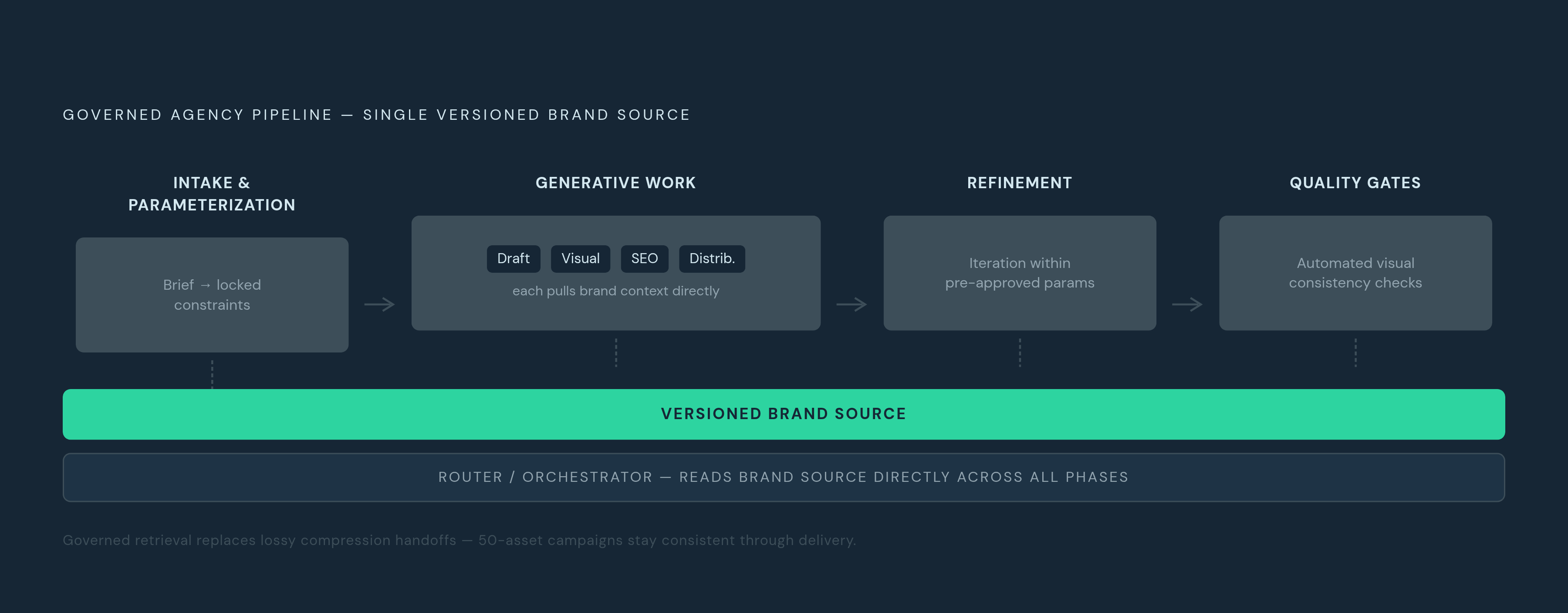
A pipeline that treats brand context as infrastructure, rather than as something re-typed into each agent's prompt, changes what a handoff actually is: instead of a lossy compression event, it becomes a governed retrieval operation. The first phase is intake and parameterization, where a creative brief gets converted into locked technical constraints before any agent generates a single asset. The decision about which model version will be used for which stage gets made here, because changing that decision mid-project is one of the most common ways style creep enters a campaign through the back door. Brand context gets retrieved from the shared source at this stage and locked to the project for its duration. The second phase is generative work. Each specialist agent, whether handling drafting, visual production, search optimization, or distribution, pulls brand context directly rather than receiving a compressed summary passed down from the agent before it. This matters because it changes what each agent is specializing in: agents specialize in their task, while interpreting brand rules has already been handled by the infrastructure layer beneath them. The third phase is refinement, where iteration happens inside parameters already approved for the project's aesthetic. The fourth phase is quality gates. Automated visual consistency checks run before anything reaches a client, so they catch any shift away from the agreed design system that crept in without anyone intending it. Catching that drift at this stage costs far less than absorbing a revision cycle after a client has already seen the work. The human role at this point in the pipeline is quality control, not remediation after the fact. The coordination layer runs beneath all four phases: the router or orchestration agent deciding which specialist to call needs access to the same brand context as everyone downstream of it, so that its routing decisions account for brand-specific constraints, such as a client that requires a formal register or a campaign locked to a specific color palette, in addition to task type.
Why per-agent prompt stuffing fails at multi-brand scale
Pasting brand guidelines into individual agent prompts can feel like it solves the problem, and at a small enough scale, it does. It breaks at the first real test of operational scale: multiple clients, multiple agents, and guidelines that change over time. Siloing is the first failure that appears. When each agent or team member works from their own copy of the guidelines, there's no single source of truth left anywhere in the system, and when guidelines update, downstream agents keep operating on whatever version someone pasted in three months earlier, with no mechanism in place to propagate the change. Volume strain appears next. Maintaining coherence across a 50-asset campaign, built by different people at different times using slightly different prompts, is a structural challenge, and style creep results when individual prompt discipline is the only governance mechanism an agency has. Operating across multiple brands creates the next failure, following directly from that. An agency running many clients can't operationalize brand consistency through prompts without creating a maintenance burden that grows with every client and every brand update, and that overhead becomes the agency's hidden cost of adopting AI in the first place, invisible on a budget line but very real in the hours it consumes. A human can reread brand guidelines before starting a task. An agent receiving a handoff from another agent can only tell whether the guidelines summarized in that handoff match the current, authoritative version of the brand if brand context has been externalized and made retrievable outside of any single prompt. Infrastructure is the right model for this problem. Brand context belongs at the workspace level, versioned and pulled by every agent on demand, the same way a codebase shares a design token file rather than relying on every developer to hard-code a hex value from memory.
Making a brand agent-ready across a pipeline
Making a brand agent-ready means every stage of a delivery pipeline, from intake through quality gates, draws on the same versioned, structured representation of that brand, rather than each agent working from its own partial, re-interpreted copy. The handoff problem that defines multi-agent systems doesn't disappear under this model, but it changes character: context still moves between specialists, but what moves is a retrieval pointer to a governed source, not a compressed summary that degrades with every pass. For an agency running multiple clients at once, that distinction decides whether a 50-asset campaign holds its brand consistency through delivery or drifts quietly until a client catches it first.