Wiring Multiple Specialized Agents to a Single Client Brand Source
A single governed brand source keeps every specialized agent on-brand.
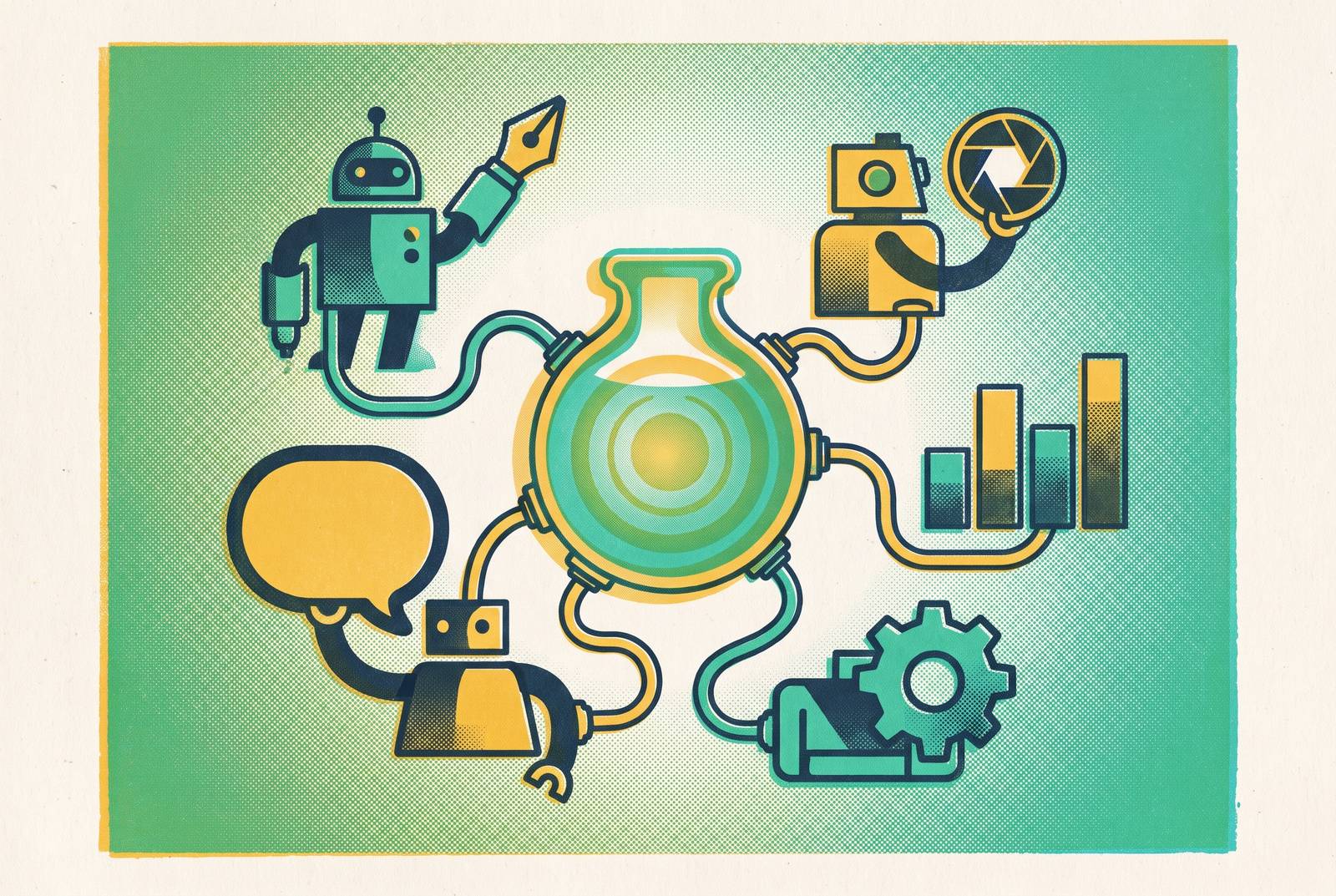
When specialized agents all draw from one client brand source, brand consistency is built into the system. A brand context layer for AI agents and products is a persistent, governed source of machine-readable rules that every agent queries before generating output. Specialization can then help agents produce more work without each having to keep its own account of the brand.
Why specialized agent fleets fracture brand identity by design
A copy agent, a visual agent, and an adaptation agent can work in parallel while drawing on different accounts of the same brand. The copy agent may have voice guidance, the visual agent may have identity specifications, and the adaptation agent may have channel instructions. Each has enough context to perform its task. But if those instructions are independent copies, nothing establishes that they reflect the same brand decisions or the same version of those decisions.
That separation makes drift structural. A capable agent can follow its own instructions exactly and still produce work that clashes with another agent’s output. Handoffs compound the problem when an agency team passes a draft to an agent without a shared source governing both. The draft conveys the work completed so far, but it cannot substitute for the full set of constraints that governed its creation. An adaptation can thus seem to keep the message while straying from the approved tone or claims.
The shift from ad-hoc generative sessions to repeatable agentic pipelines makes this distinction consequential. Creative assets become data-driven outputs, so how the pipeline is built shapes how well they follow the brand before generation even starts. Better prompting alone cannot make separate copies of brand knowledge agree. Generic, unshared context also contributes to the “sea of sameness” in AI-generated content because nothing consistently anchors production to a brand’s distinctive identity. The architectural requirement is therefore not simply more context, but a common authority for it.
What a shared brand source actually means as infrastructure
A shared brand source is a persistent, governed context layer that every agent queries before generating anything. It separates brand knowledge from the agents that use it. Context management supplies the relevant information, shared knowledge provides one memory, and task distribution assigns work to specialized agents. Continuous improvement completes this agentic OS pattern by making the knowledge and workflow subject to ongoing refinement.
A copy agent needs guidance on voice and which phrases are banned, while a visual agent needs hex codes, typography hierarchy, and rules for imagery. Their context slices differ, but their authority does not. Both draw from the same governed source, so specialization changes what an agent retrieves rather than which version of the brand it follows. This is the distinction between sharing context and copying it.
The source takes practical form as a versioned brand playbook covering voice, tone, messaging, legal and compliance constraints, and visual usage. Its contents become retrieval-ready rules, including required style, approved claims, prohibited language, and channel-specific formats. Governance belongs in that structure from the beginning. Adding it after deployment leaves teams trying to reverse drift already embedded in their workflows.
An 80-page PDF serves a different purpose. It is an artifact for people to read. Holding approved materials likewise is not enough to make a digital asset repository a brand context layer. Along with storage, it needs a way to control access to the rules that apply.
Making brand identity machine-readable before wiring agents to it
A common source only works if agents can interpret its contents reliably. Brand strategy, voice, and visual identity must therefore be set out as machine-readable specifications before agents can use them as shared infrastructure. A structured Markdown file or equivalent can hold this “Brand Intelligence,” provided its rules are explicit enough for a language model to ingest without ambiguity. The translation is substantive work.
For example, a HEX color value identifies a color but does not explain its permitted uses. A usable specification includes that usage context. Typography entries need to show the hierarchy as well as font names, while voice guidance needs rules that spell out which language is allowed and which is banned. Modular prompts and negative constraints make banned words and imagery directions explicit. Structured JSON or another data serialization format can express these rules in forms agents can parse, validate, and apply automatically.
A canonical description that is the same across surfaces, a clear category-plus-audience claim, and machine-readable identity links help AI engines tell which brand entity they are dealing with. Brand recognition and creative execution both depend on making identity explicit.
The practical requirement is to preserve the relationships within the rules. A color belongs to a usage context, a font occupies a hierarchy, and a claim sits within legal and messaging constraints. Removing those relationships can leave a specification readable but incomplete. Conversely, centralizing ambiguous prose merely distributes the same uncertainty to every agent.
How MCP connects every agent to the brand source without per-agent integration work
Model Context Protocol, or MCP, provides a common way for compatible agents to query the brand source regardless of the model powering them. Without a shared protocol, each pairing of an agent and a tool needs its own integration. An MCP server instead exposes voice rules, visual identity, positioning, and prohibitions through an interface compatible tools can query before generating words or images. Brand knowledge becomes something the agent checks at query time rather than something it half-remembers from training.
OpenAI, Google DeepMind, Microsoft, and Cloudflare have adopted MCP, broadening it beyond a single vendor’s standard. MCP SDKs reached 97 million monthly downloads by April 2026. That adoption gives the shared-source architecture a broader base of compatible agents. It reduces dependence on a separate connection pattern for each tool.
Dash Social launched its MCP integration in August 2026 to bring proprietary brand intelligence into AI workflows, including ChatGPT and Claude. The integration exposes a brand’s own data across social performance, community insights, listening, competitive benchmarking, and Vision AI. It illustrates the connection pattern in production. Agents can query the brand’s own data as they generate work, bringing it into the generation workflow.
The scaling trade-off is context overhead. Tool definitions for connected MCP servers can load into chat context on every model turn. Modern clients such as Claude Code defer loading through lazy loading or tool search, but high tool counts can still introduce token overhead and reliability differences compared with CLI approaches. The emerging approach combines MCP with CLI wrappers. For smaller teams with fewer connected tools, that trade-off is narrower than it is for a heavily connected fleet.
How specialized agents divide labor while sharing the same brand context
A Strategy Agent begins by analyzing a brief against brand positioning. A Copywriting Agent then develops a master campaign narrative using the same source’s tone and messaging rules. An Adaptation Agent reformats and rewrites that narrative for different platforms, following each channel’s practices while staying true to the brand identity. Handoffs pass work from one specialist to the next, while each still gets brand context from more than the previous agent’s output.
A Brand Guardian Agent adds evaluation to that sequence. Its role is to assess drafts against stylistic and compliance guidelines before a human sees them. If a Creator Agent uses a banned word or breaks tone, the Guardian returns the draft for a rewrite. The resulting pipeline runs from Strategy to Copy to Adaptation to Brand Guardian. Review is a defined stage rather than an informal expectation attached to the handoff.
Human involvement then varies with the stakes of the content. Low-stakes work can run automatically under the rules, while mid-tier work is AI-generated and then edited by a human. Regulated or high-visibility content is AI-drafted with full human approval. Shared context supplies the foundation for the automatic tier, but it does not remove the need to define which work belongs there. The handoff framework must be documented.
This arrangement makes specialization compatible with coherence. Each agent concentrates on a narrower task while drawing its constraints from the same authority as the other agents. Without an explicit human-AI handoff, even well-structured generation can end in publication without the intended review.
Keeping the shared source current as the brand changes
A shared source can distribute stale context as efficiently as current context. Campaigns change, legal constraints are revised, visual identities are refreshed, and voice evolves. If the central source stays unchanged, every connected agent can get instructions that no longer fit the brand. Centralization can turn several outdated copies into a single point of staleness.
Versioning brand context like code addresses that operational risk. When the governing context changes, the update must propagate to every connected agent, just as a dependency update propagates to the services consuming it. The architecture’s requirement is that agents no longer operate on the prior version once the update applies. Merely editing a central document does not establish that condition. The source must function as the live authority used by the workflow.
This also changes how governance is maintained. Compliance rules, claims constraints, and regulated-content restrictions become live agent constraints. When a rule changes, the governing constraint changes instead of requiring teams to revise separate prompt templates. That is the operational benefit of separating brand knowledge from task instructions. Agents can keep their specialized roles as they get the updated brand context.
For agencies, the requirement applies separately to every client. Each brand needs its own versioned source, and an update to one must not propagate to another. As an agency scales beyond five clients, the relevant question is not a numerical threshold but whether automated workflows preserve those boundaries. Multi-brand management must be a first-class workflow. Centralization is useful only if it keeps each client’s authority distinct while making that authority available across the client’s production pipeline.
Reviewing AI output against the brand before it ships
Shared instructions govern generation, but they do not establish that the resulting asset complies. Output still needs review against the brand before it reaches an audience. When multiple agents produce work at speed, people cannot reliably keep up by spot-checking it. The workflow must therefore include automated review based on evidence, leaving people to make the calls that need creative or legal judgment.
Tiered pre-flight checks flag potential brand violations and technical errors before an image, copy block, or video reaches a human reviewer. Those checks need more than a pass or fail. Each result should connect the reviewed output to the specific brand rule used to assess it. That traceability gives reviewers a basis for understanding the finding and supports legal and marketing audit requirements. It also keeps evaluation anchored to the governed source rather than to another agent’s independent impression of the brand.
Video introduces an additional compliance obligation. New York’s synthetic performer rule, effective June 9, 2026, requires conspicuous disclosure of synthetic performers in covered advertisements, with an actual-knowledge qualifier applying to the producer or creator. The rule makes review of regulated-content a matter of compliance as well as quality. Automated pre-flight checks can support that review, but a generation pipeline does not discharge the obligation simply because it used approved brand instructions.
The complete architecture connects brief creation, generation, adaptation, and review to the same governed layer. Each stage draws from that authority and reports back to it, while the review stage tests the actual output against the applicable rules. Inconsistency began as a structural problem, and review closes the structural solution by checking that shared context survived every handoff.