Treating Client Brand Kits as Inherited Config Across Every AI Agent Workflow
Shared brand rules accessible to every AI agent ensure consistency across multi-agent workflows.
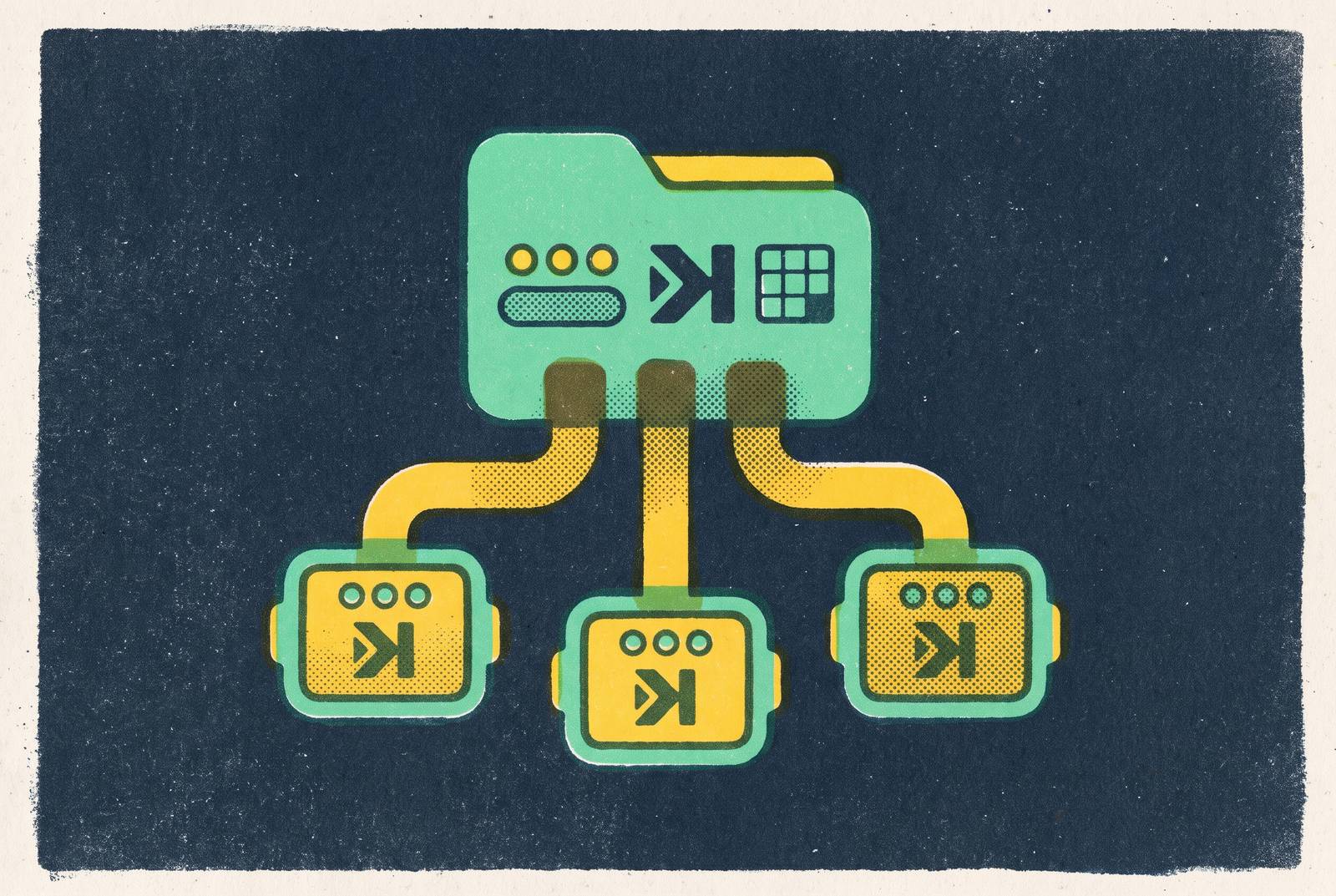
The brand layer for agents is a shared, machine-readable source of brand rules that every agent queries before generating work. Treating client brand kits as inherited configuration makes consistency a system constraint. Across agency AI workflows, this is the model that scales because the rules persist across agents, sessions, and tools.
Why brand consistency breaks down when agents run the creative work
Demand for AI-generated assets has outpaced the mechanisms that bring brand rules into production. Non-designers build assets from outdated templates, external partners interpret guidelines from PDFs that are months stale, and rushed teams skip format adaptation. These failures have a common structural cause. The people and systems producing work do not reliably receive the same, current definition of the brand.
Agent workflows multiply that gap because each participant can operate from a private, incomplete copy of the rules. A copy agent may have the approved voice guidelines while an image agent has no visual system to work from. Each output can look acceptable in isolation. Together, however, the outputs express different interpretations of a brand that was supposed to be shared.
For an agency, the coordination burden repeats across every client, agent, session, and tool. Each account has its own constraints that someone must find and enter correctly. More careful prompting can make one result better, but someone still has to do that work each time. The failure is architectural rather than executional because no shared mechanism keeps the participants aligned.
What it means to treat a brand kit as inherited configuration rather than a repeated prompt
A prompt supplies instructions for a session, while inherited configuration supplies persistent rules that an agent reads before acting. The distinction is between a reminder and a protocol. Configuration sits in a queryable location, much as file permissions sit outside the request to open a file. Its availability does not depend on the person writing the next brief.
A human-readable brand book explains the brand to people, whereas machine-readable configuration expresses those rules in a form automated systems can consume at runtime. Design tokens store the rules for how the brand looks as structured variables. Voice rules become queryable constraints. This preserves the brand book’s intent while changing how production systems access it.
Pasting guidelines into every system prompt does not make them inherited configuration. Someone still has to maintain every copy. If someone forgets an update, one tool keeps using rules that another has already replaced, even if both prompts had all the rules to begin with.
In the atomic brand kit practitioner case, the brand kit was a zip with two folders, /human and /agent. The latter encoded the brand as YAML, JSON, Markdown, HTML, CSS, and SVG files. Dropping it into Cursor produced a near-complete landing page that day. A second audience could now use the same brand without another written briefing.
How can multiple AI agents access the same brand identity and guidelines?
MCP, or Model Context Protocol, provides the delivery mechanism for shared brand context. It is an open standard through which a model can query external data, rules, and files before generating output. For a brand kit, that means replacing an attachment with a live source. Voice rules, visual tokens, positioning, and specific do’s and don’ts become available to connected agents through the same interface.
The defining advantage is that the protocol is model-agnostic. An agent running on Claude, ChatGPT, or another MCP-compatible model can access the same brand context without a custom integration rebuilt for each tool. OpenAI, Google, Microsoft, and Salesforce have added support. That breadth allows brand infrastructure to remain separate from the choice of agent.
Configuring the workflow must establish automatic querying as its operating rule. MCP makes the shared source accessible, while the inherited-config architecture makes consulting it part of production. This distinction keeps the implementation claim precise.
Enterprise-Managed Authorization became stable in June 2026. It allows organizations to provision MCP server access centrally through their identity provider, giving users connected servers on first login without per-app OAuth setup. For agencies, central access provisioning supports a shared infrastructure serving many client accounts. Brand data consequently becomes a marketing decision as well as a technical one, because its structure determines what agents can do with it.
What a brand kit structured for machine consumption actually contains
A machine-readable brand kit translates guidance into structured variables without discarding its meaning. Colors, typography, and spacing belong in design tokens stored as structured JSON that agents reference at runtime. A token such as color.surface.elevated tells an agent what a surface is for, while a raw hex value supplies only the color.
The same structured file should include voice and tone rules, including tone register, prohibited terms, passive-voice avoidance, and CTA style. Visual and verbal identity are not separate briefing problems. Both constrain the asset, so both need to be available when an agent generates it. The underlying principle is that each rule in prose should have a machine-readable equivalent.
Agents connected to a living design system can pull buttons, cards, and headers from approved building blocks. Templates should remain separate from tokens, with their own versions, rollback, and branches for sub-brands or campaigns.
The /human and /agent structure therefore represents more than a convenient folder arrangement. It gives each audience an appropriate expression of the same identity. The implementation succeeds when the structured files preserve the guide’s decisions, rather than reducing the brand to a palette and a logo.
How shared brand context changes what agents can do across a multi-agent workflow
Shared configuration becomes a system constraint when copy, image, social, and email agents all query it. The agents no longer need separate briefings to establish the same baseline. The same governing context across their different tasks allows individually generated assets to form a coherent campaign.
Adobe describes how the gap between insight and campaign launch compounds across planning, creative production, asset approvals, and cross-channel activation. Some of the context can get lost at each handoff. A shared context layer allows agents to act on the same signal without re-briefing at every stage, connecting the campaign’s intent to its execution.
Production volume supports the argument but does not define it. Teams that use token-based generation and automated brand validation say they make many more assets per designer-hour while following brand rules as well as or better than before. Increased output need not require weaker controls when checks are part of the production pipeline.
That does not remove the need for human judgment. Automated checks test whether work follows the rules, while designers review how good the creative work is and senior reviewers judge flagship work. The durable advantage lies in the quality of the shared brand context. Agents can become increasingly interchangeable without making a client’s identity interchangeable.
Why agencies managing multiple client brands need this architecture more than anyone
Agencies need shared infrastructure that preserves separate identities. The 4As Look Ahead 2026 describes agencies as “relationship designers” defining boundaries, feedback loops, and governance as agents make micro-decisions in marketing, communications, and customer experience. This places the agency’s responsibility beyond generating content. The agency must also set rules that keep automated work in line with brand values and what people expect.
Multi-tenant configuration gives that responsibility an operational form. Each client has separate brand tokens, voice rules, and approval constraints that the agent working on that account queries. The infrastructure can be shared without sharing the identity.
Governance belongs within those account-specific constraints. Frequency caps, approval thresholds, and no-go zones travel with the brand kit instead of relying on a conversation someone may miss. Agents can generate and stage content, but a person still has to approve it before it is published.
For a lean agency, this changes where coordination effort goes. A small central team can set strategy for many brands because routine constraints are encoded instead of kept in people’s heads or spread across Slack threads and Notion pages. The work shifts from repeating instructions to maintaining the boundaries within which each account operates.
Keeping brand config current when the brand itself changes
Stale inherited configuration enforces the wrong rules at scale. That makes freshness part of the architecture. Brand tokens need to be version-controlled like code, with palette, typography, and tone changes made at the shared source. Every agent querying the current version then receives the revised rules without prompt-by-prompt updates.
Templates need their own version history so older versions are there for rollback and versions for each sub-brand or campaign stay separate. Freshness monitoring checks whether agents are querying current context. A central file alone is not enough if production still reads yesterday’s version.
The code-dependency analogy is useful because it locates change at its source. A software team updates a dependency. Similarly, a client rebrand becomes an update to the configuration agents consume, rather than a re-briefing exercise across every tool and person on the account.
Reviewing AI-generated work against the brand before it ships
The same configuration that briefs an agent can also grade its output, closing the production loop. Generated work is checked against the brand system before reaching a human reviewer. Review therefore tests the asset against the rules that governed its creation, rather than against a separate interpretation introduced afterward.
Automated checks cover color, typography, tone, and composition, together with file specifications and accessibility requirements. Evidence-backed review records which rule was checked, which version of the brand configuration applied, and what the result was. A disputed color becomes a traceable compliance question.
A designer reviews creative quality in batches, senior review applies to flagship work, and stakeholder approval covers legal or regional requirements. The agent tracks status and routes the work accordingly.
For agencies, the resulting check log also supplies an accountability record per asset and client. If a client questions whether the brand was applied correctly, the agency can show the relevant rule and result. Designers can consequently devote their attention to interpretation and creative quality instead of repeatedly checking whether the approved shade of blue was used.
What the brand-as-infrastructure model requires an agency to do differently
An agency adopting this model should move brand knowledge into a queryable, versioned store that its agents and products can read. The brand book remains useful to people. It no longer serves as the only operational source for automated production.
Someone on the account team must own the configuration as a developer owns a dependency. When the client’s brand changes, that person must update the source even if a new PDF is sent out. Ownership belongs close enough to the account to keep the encoded rules aligned with the client’s decisions.
Approval workflows should also be part of each client’s constraints instead of steps someone adds by hand after the work is generated. Evidence-based review completes that change by making the brand check log available with the finished asset.
People still have to make creative judgments, build client relationships, and decide on strategic positioning. The system takes responsibility for the repeatable constraints that do not require interpretation. A new agent provides the operational test. It should produce on-brand output on its first run without anyone re-briefing it, because the client’s configuration is already there.