Pricing AI-Assisted Agency Services Without Undercutting Value
Agencies charging by the hour lose revenue when AI makes them faster—here's what to charge instead.

Advertisement
Hourly billing fails AI-assisted agencies for a mechanical reason, not a relational one: the model converts efficiency into lost revenue. When AI compresses a deliverable that once took many hours into a fraction of the time, the agency billing by the hour earns a fraction of the same fee for the same output, or better output. Clients are not the source of the pressure. The arithmetic of the invoice is.
The scale of the exposure is already visible in the market. A 2025 survey of more than 180 agencies found that roughly a third had already received explicit "AI discount" requests from clients, and roughly half expected them soon, concentrated almost entirely at firms still anchored on hourly rates. Hourly billing puts the agency's cost structure directly on the invoice, and a client reading that invoice can see the hours fall as tools get faster. The negotiation opens on its own, without a client needing to be adversarial about it: fewer hours logged reads as a lower price owed, regardless of what the work produced.
Speed is the actual contribution AI makes to agency work, and the hourly model turns that contribution into a liability. When an agency gets faster, it earns less for the same result, and the incentive runs backward from the value it creates. A firm that masters a workflow and delivers it in half the time has, under hourly billing, cut its own fee in half. Agencies sometimes defend the hourly model on the grounds that clients trust what they can track. But trust built on time-tracking is weaker than trust built on transparency about value delivered, and a billing structure that invites AI-discount demands is the less transparent one in a market where every client already knows these tools exist.
The macro signal: what WPP's public commitment tells boutique agencies
The pricing shift is no longer a boutique experiment. WPP disclosed in its Q1 2025 results that performance-linked fees account for 20 to 25 percent of net sales, and CFO Joanne Wilson told analysts the company intends to keep moving in that direction: "A commercial model that is more closely linked to client outcomes will enable us, over time, to move away from time and materials and decouple revenue from headcount." Wilson described the shift as an evolution rather than a finished transition, and the distinction matters. WPP's disclosure describes a mix of output-based and KPI-adjacent structures, and that is not yet a full switch to pay-for-results. The direction is declared. The destination is not yet reached.
That caveat does not weaken the signal for boutique agencies, it sharpens it. The largest holding company in the industry has put a number and a quote behind the idea that hours are the wrong unit of account, and McKinsey has separately moved a meaningful share of its global fees onto measurable client outcomes. Two of the industry's most conservative operators making the same move in the same window is not coincidental. Boutiques that wait for their own clients to force this conversation are ceding the framing to firms that are already rewriting it from the top of the market down.
The six pricing models replacing the hourly invoice
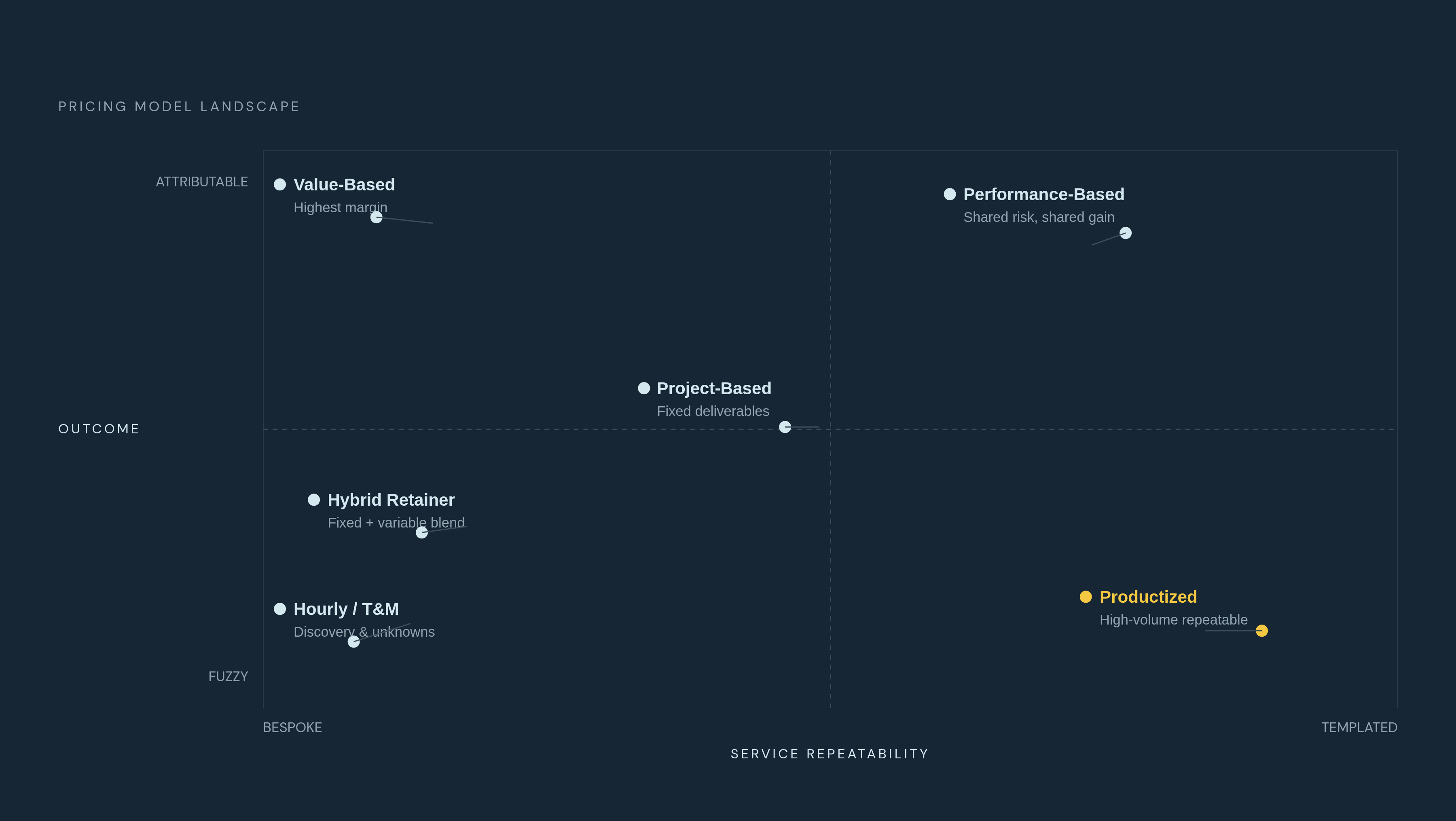
No single model replaces hourly billing across all agency work. The right structure depends on how repeatable the service is and how measurable its outcome is, and the clearest way to choose is to plot each service on those two axes: repeatability, running from bespoke to templated, and outcome measurability, running from fuzzy to attributable.
Hourly or time-and-materials billing still belongs in discovery phases and in consulting scope that is genuinely unpredictable before the work starts. AI specialists already charge a big premium over generalist hourly rates, but the structure caps the agency's upside, and it invites the AI-discount conversation once delivery speeds up. Project-based pricing suits defined deliverables such as chatbot implementations or automation builds, where the scope can be fixed in advance; it rewards efficiency more directly than hourly billing, but it depends on accurate scoping and clear boundaries around change requests. Value-based pricing ties the fee directly to business impact and represents the highest-margin model available when outcomes are quantifiable and clients are willing to share the metrics that make the calculation possible, though it demands the most rigorous discovery process of any model on this list.
Productized pricing fixes the scope, the price, and the delivery schedule, and it is built for repeatable, AI-accelerated services, the clearest fit being high-volume, low-variation work like social content batches. Because the price is fixed regardless of how fast the work gets done, productized pricing stabilizes revenue and lets the agency keep the full efficiency gain. Performance-based pricing ties the fee to a percentage of revenue generated or costs saved, so it aligns agency and client incentives more than any other structure here, but both sides need to agree on shared data access and an attribution method before work begins. A hybrid structure, a fixed base fee paired with performance bonuses, is increasingly common precisely because it resolves the tension between the two: fixed pricing is easier to sell and rewards efficiency, variable pricing captures upside and shares risk, and the hybrid captures some of both. On the mapping framework, productized pricing wins where work is repeatable and measurable, a hybrid retainer wins where work is bespoke and fuzzy, and performance-based or value-based pricing wins where work is measurable and attributable even if it isn't repeatable.
How value-based pricing works in practice for AI-assisted deliverables
Value-based pricing is a calculation, not a philosophy, and the discovery process that produces its inputs is what an agency is actually selling when it proposes this model. The standard formula is Project Price equals Annual Value Created multiplied by a Value Capture Rate, and as of 2026, most agencies price at 20 to 40 percent of the client's first-year value from the automation. An automation that saves a client a substantial sum in annual labor costs, priced at a fraction of that value under a standard capture rate, yields a project price that still leaves the client a strong return in Year 1 and pure benefit in every year after that. Brand strategy work shows the same logic from another angle. AI can compress delivery to a fraction of the hours a project once required, but value-based billing holds the fee close to its original level because the fee was tied to the value delivered, not the hours spent. The strategic insight is the product, so it commands the same fee whether it takes forty hours to produce or four.
You start calculating client value in discovery, and five categories cover most of what an agency needs to quantify. To find labor savings, you multiply hours automated by fully-loaded hourly cost, then by 52 weeks. Revenue can rise from conversion improvements, personalization gains, or new capabilities the automation makes possible for the first time. To find error reduction, multiply cost per error by the reduction in error rate, then by annual volume. Speed-to-market value comes from the revenue a client captures by launching faster, or the opportunity cost it avoids by not launching late. Capacity unlocks capture the revenue a client can now pursue once a bottleneck is removed.
Surfacing these numbers depends on asking the right questions during discovery: how many hours does the client's team spend on this task weekly, what is the error rate and what does each error cost, and what revenue opportunities is the client currently missing because of capacity constraints. The proposal should show this math openly. Clients respond well to that transparency, and the numbers give their own internal stakeholders the ammunition they need to justify the spend to their own leadership. Among agencies charging at the top of the market, the distinguishing factor is the discipline of pricing on value delivered.
The obvious objection is that clients will not share the metrics a value-based calculation requires. Sell a bounded, fixed-fee discovery engagement before the main project begins. That engagement delivers a roadmap of automatable tasks with ROI estimates attached to each one, and it does two things at once. It gives the client a standalone, useful deliverable even if they go no further, and it anchors the price of the main project to the value just calculated.
The hybrid retainer structure that generates recurring revenue from AI agent work
For most AI agent work, a single project price is the wrong tool. The billing model that actually matches the cost and value profile of this work pairs a one-time setup fee with a recurring retainer. Building an agent system carries a real upfront cost in architecture, integration, and testing. Operating that system costs something different on an ongoing basis, in monitoring, prompt optimization, correcting model drift, and expanding scope as the client's needs change. These are not the same work, and pricing them as if they were leaves one phase or the other underpriced.
If you don't build in usage buffers, token economics make a flat retainer risky. AI tool costs move with usage, not with time, so a content-heavy client can burn through many times more tokens than a lighter one, quietly eroding the margin on a retainer that looked profitable the day it was signed. The Agent Licensing Model addresses this directly: a setup fee, benchmarked for autonomous agent systems, paired with a monthly license that covers maintenance, API cost fluctuations, and model upgrades. The agency keeps the IP in this structure, so it gets a recurring revenue stream and real leverage in the client relationship, because the client licenses ongoing access.
Retainer tiers typically scale across four levels of engagement. A basic monitoring tier is the entry level, covering uptime, error alerts, and a monthly report. An active management tier adds one new micro-workflow per month along with ongoing prompt optimization. A growth partnership tier adds proactive recommendations, unlimited small changes, and priority support. A full agency partner tier adds dedicated resources, a custom dashboard, and a monthly strategy workshop. The commercial logic behind all four tiers is the same: price the setup fee low enough to win the initial engagement, then monetize the operating phase through the retainer. The setup is the customer acquisition cost for a recurring revenue line, so it isn't the main event.
Infrastructure that keeps updating earns its place as a retainer line item because the updates themselves are the ongoing value a retainer captures. A system of versioned, API-accessible brand context that agents pull from on an ongoing basis is a clean example: every time the underlying context updates, every connected agent inherits the change automatically, which is exactly the kind of compounding, ongoing value a retainer is built to capture.
Brand infrastructure as a billable deliverable, not a setup cost
Generation speed is not the hardest problem in AI-assisted creative work. Keeping every output on-brand across agents, channels, and updates is, and agencies that solve that at the infrastructure level are selling something worth far more than prompt-writing skill. Brand guidelines written for human designers do not translate to AI systems in any direct way. A principle like "modern" or "trustworthy" means something to a human designer with years of accumulated context, but an AI system cannot interpret that kind of vague language, cannot reliably extract context from prose, and cannot understand how separate design elements relate to one another. Left with only a PDF of guidelines, AI produces on-brand output by accident.
Guidelines are shifting from a static document to a queryable, machine-readable layer of brand context, where humans read a portal and AI queries an API, and both draw from the same source of truth. Machine-readable brand guidance looks nothing like a traditional style guide. LLM-ready instructions convert brand intent into short, unambiguous rules: exact words to use or avoid, strict character limits, output patterns specified down to the line, such as a headline capped at eight words or two to three bullets each kept brief. The format resembles a formula more than it resembles prose, because a formula is what a model can actually follow.
The mechanism that turns this into ongoing value is a live connection, an MCP link or a canonical machine-readable URL, that any AI platform can pull from directly. If you update the source once, every future output across every connected tool inherits the change. That is the structural case for billing brand infrastructure as a retainer line rather than a one-time setup fee: the value of a versioned, always-current brand context compounds every time a new agent, a new channel, or a new campaign draws from it. Bloom builds exactly this layer: it ingests a brand's existing assets and turns them into a structured Brand Skill that agents retrieve through an API or MCP, so every connected tool works from one canonical source instead of scattered, drifting prompt copies. For an agency managing several client brands at once, that means consistency that scales across every engagement instead of drift that compounds across every one of them.
The market is already pricing this capability as infrastructure. Platforms built for housing brand guidelines now get ranked specifically on machine-readability, and machine-readable delivery to AI tools carries the most weight among current evaluation criteria, so clients and evaluators are starting to treat it as a procurement requirement.