Multi-Client AI Workflow Architecture for Agencies
Advertisement
An account manager opens a new prompt window for the fourth client of the week and starts pasting in brand guidelines: the tone rules, the approved terms, the colors, the escalation policy, all typed or copied fresh because that's how the last client's config got built too. Multi-client AI workflow architecture starts failing at exactly this moment, because nothing about the individual prompt is reusable or structural. Building a separate configuration for each client feels safe, since each client's setup is walled off from every other client's. But isolation built by copying instead of by design doesn't hold up, because nothing connects the copies once they exist.
Consider what happens when the agency's shared writing framework improves, or a client goes through a rebrand. There's no path for that change to travel. Either the update gets missed in some subset of client configs, or someone has to open every single one and edit it by hand. AI automation agencies that build and maintain production systems treat this as a first-order planning concern: AI models drift, APIs change, and workflows break silently over time, so the real question before any build is never just what gets built, but how it gets monitored and kept current after go-live. Config drift across a client roster is that same failure mode playing out across accounts.
The arithmetic gets worse as the roster grows. A setup that's merely annoying at three clients, each with its own pasted-together config, becomes structurally unworkable at fifteen, because the number of places a single change has to be manually replicated scales with the number of clients, not with the complexity of the change itself.
What a three-layer architecture separates
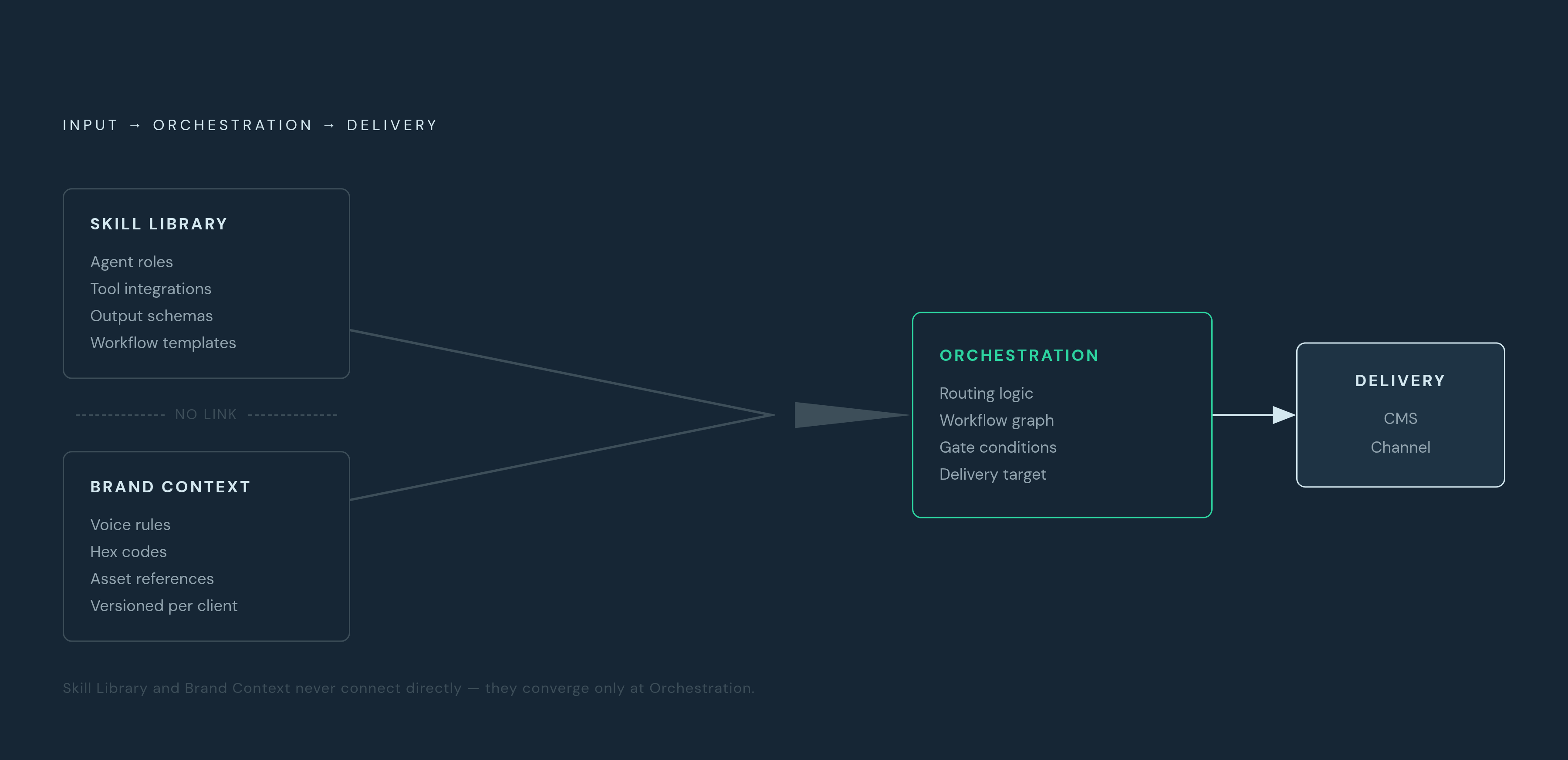
The fix is to stop treating "per-client configuration" as a single object and split it into three distinct layers: a shared skill library, a per-client brand context layer, and an orchestration layer that joins the two for a given task. Picture three boxes. The first, labeled shared skills, feeds into the third, labeled orchestration, with an arrow running one direction. The second, labeled client context, feeds into the same orchestration box from the other side. Orchestration then routes an output downstream to delivery. Nothing moves directly between the skill library and the context layer. All the value in this architecture comes from keeping it that way.
Multi-agent system design in 2026 describes this same division as standard practice: individual agents carry their own tools, memory, and policies, while a separate planning and routing layer assigns tasks, reconciles outputs, and enforces constraints across the whole system. The constraint layer, in agency terms, is exactly where client brand rules belong. It is the constraint layer, not where agent capability lives, and conflating the two produces the fifteen-client maintenance trap.
Three layers will look like more moving parts than a single config file per client, and at the start, it is. The honest objection is that this looks like added complexity for no immediate payoff. But a flat, one-file-per-client design grows in maintenance cost in direct proportion to the number of clients: twice the clients, twice the places a change has to be made by hand. A layered design does not grow that way. A skill upgrade gets made once. A brand update gets made once. The cost of adding a sixteenth client is closer to zero than to the cost of adding the second one.
Layer one: the shared skill library and the agent roles that belong in it
The shared skill library holds everything that has nothing to do with a specific client: agent roles, tool integrations, output schemas, workflow templates. Its usefulness depends entirely on keeping anything client-specific out of it.
A seven-role taxonomy, Researcher, Drafter, Auditor, Reviewer, Deployer, Router, and Escalator, is a workable model for what belongs here. A Researcher gathering competitive intelligence for a SaaS client runs the identical role definition as a Researcher gathering clinical messaging precedent for a healthcare client. What changes between them is the instruction set injected at runtime, not the role itself. A research-and-brief pipeline has a Researcher and Drafter hand off into an Auditor, and a content-draft pipeline has a Drafter produce copy that an Auditor checks against rules before a Reviewer signs off. Both pipelines use the same role definitions regardless of which client's task is running through them.
Output schemas belong in this layer for a structural reason, not a stylistic one. When one agent's output becomes the next agent's input, unstructured prose creates a parsing problem: the receiving agent has to interpret free text, and that interpretation step is where errors creep into a handoff. A JSON schema with required fields removes the ambiguity, and it's a schema that applies across every client workflow built on that handoff pattern, since the shape of the data an Auditor needs from a Drafter doesn't change based on whose brand is involved.
Tool integrations, CMS connectors, CRM write-back, search APIs, sit in the shared layer for the same reason. The integration logic is shared infrastructure. What varies per client is which credentials get injected at runtime to point that integration at the right account, not the mechanics of the integration itself.
Framework choice follows the shape of the workflow and the identity of the client plays no part in it. LangGraph suits graph-structured, durable workflows. CrewAI suits role-based setups where getting to a working scaffold quickly outweighs fine-grained control. Mastra suits agencies already standardized on TypeScript. Most agencies land on two frameworks across their whole practice and choose between them based on what a given workflow looks like, not based on which client commissioned it.
Human review gates are also a shared-layer decision, and placement changes how much effort a reviewer has to spend finding issues. A gate placed after the Auditor, rather than directly after the Drafter, changes what a reviewer is looking at: a raw, unaudited draft takes real effort to review because every issue still has to be found by the human. An audited draft, with issues already surfaced, lets the human confirm or overrule flagged items instead of hunting for them cold, cutting review time substantially. That gate placement is a property of the workflow graph, and it holds across every client that graph serves.
What doesn't belong in this layer is anything that encodes a client's identity: brand voice instructions, client-specific approval thresholds, terminology lists. Those are context, and context changes per client. Putting them in the shared layer is the single fastest way to recreate the maintenance trap the architecture is meant to solve.
Layer two: why brand context must be structured data, not pasted prose
Per-client brand context earns its place as a real layer only when it exists as structured, versioned data an agent can retrieve at runtime, not as a block of guidelines a person pastes into a prompt before each task.
The problem with pasting guidelines by hand isn't a discipline failure on the part of whoever is doing the pasting. Every person who writes a prompt pulls the brand in a slightly different direction, because there's no shared, machine-readable rule set behind the prompt, only a human's best recollection of the guidelines plus whatever got copied that day. Consistency requires rules the machine itself can read and apply the same way every time.
That means converting vague, human-interpreted guidance into rules an agent can actually operate on. "Sound friendly" has to become something specific: use contractions, write in second person, keep sentences under a set length, avoid jargon. Visual guidance needs the same treatment: exact hex codes rather than a described color family, no gradients, photography rather than illustration, a minimum logo clear space stated as a number. Agents don't interpret intent the way a trained human reviewer does, so the instruction has to already be at the level of specificity a human would only reach after years on the account.
Image generation makes the gap especially visible. A text prompt describing a brand's look falls short whenever an exact color match or a specific typeface is required, because description leaves room for the model to infer, and inference is where brand drift enters. Supplying actual references, a color palette file, a font sample, the official logo, points the model at the real asset instead of a description of it, though even with references, exact color and font fidelity can still need correction after generation. Most foundation image models also don't carry brand context from one generation to the next: a strong result coaxed out of a generic tool through careful prompting doesn't persist, and the next generation starts from zero again. A brand context layer solves that by keeping the reference external to the model's memory, supplied fresh each time.
This is the layer where Bloom's Brand Skill fits, built to be exactly this kind of infrastructure: a versioned, retrievable representation of a brand's aesthetics, voice, references, and assets, reachable by API or MCP. It connects to Claude, Cursor, ChatGPT, and any MCP-compatible environment. The brand context travels with whatever tool is doing the work instead of needing manual re-entry each time a workflow runs. Versioning this context the way code gets versioned means a client rebrand becomes a single update to one object, and every downstream agent pulling from it inherits the new version automatically. For agencies running several clients at once, treating each client's Brand Skill as its own discrete, managed object means updating one client's context never touches another's, and the orchestration layer always fetches the version tied to the correct client identifier.
Layer three: orchestration logic that joins skills and context without conflating them
The orchestration layer is runtime logic: given a client identifier and a task, it decides which shared skills to call and which brand context to inject. Its job is to connect those two layers, not to hold a copy of what either one already contains.
In production, an orchestrator behaves like a workflow engine with firm rules rather than something closer to free-form collaboration between agents. It takes in a goal, breaks it into discrete tasks, assigns each to a specific agent, routes messages between agents, verifies outputs against expectations, and decides what happens next or when to stop. Four things belong specifically at this layer: the client routing logic that determines which context object to pull, the workflow graph that determines which roles fire and in what order for a given task type, the gate conditions that determine when a human needs to review something before it proceeds, and the delivery target that determines which CMS or channel receives the finished output.
What must stay out of this layer is just as important. Brand rules themselves live in layer two. Agent role definitions live in layer one. If either one gets duplicated into the orchestration layer, the agency has rebuilt the same maintenance problem one level up, just under a different name.
Observability at this layer isn't optional. LangGraph Studio's time-travel debugging and n8n's integration with LangSmith both exist to answer a single question: why did a given agent produce the output it produced. Without that visibility, tracing a brand consistency failure back to its cause across a multi-client workflow is close to impossible, which is reason enough to weigh a built-in debugger for agent state as a real requirement when choosing a platform, not a nice-to-have.
Security sits here too, in brief. Tool permissions should carry a risk tier, read-only, write, irreversible, and auto-approval should be switched off for anything in the irreversible tier. Those permission boundaries do more to limit what can go wrong in production than the choice of underlying model does.
The Escalator role also belongs at this layer, functioning as a safety valve. When a workflow hits a case it isn't built to handle, the Escalator surfaces a structured ticket for a human instead of letting the workflow guess its way forward, which keeps every client's workflow from making a bad call under uncertainty. Once these three layers are genuinely separate, the next question is how a change made in one of them actually moves through the system.
How changes propagate when the layers are kept separate
A layered architecture proves itself in exactly one test: a change made in one layer has to reach everything that depends on it, and nothing that doesn't. Two scenarios cover most of what an agency will ever need this architecture to do.
The first is a skill upgrade. Suppose the Auditor agent's rubric gets better at catching a certain class of factual error. That change is made once, in the shared skill library. Every client workflow that calls the Auditor role inherits the improved rubric the next time it runs. No client-specific configuration gets touched.
The second is a client rebrand. Suppose a client changes its primary brand colors and shifts its tone. That change is made once, in that client's brand context object. Every task the orchestration layer runs for that client from that point forward pulls the updated context automatically. No other client's workflow is affected, and nobody has to edit a workflow graph to make it happen.
Superside's engagement with Maven Clinic after a rebrand shows what this looks like under real time pressure. Maven needed new marketing materials quickly following the rebrand, and Superside met that need by training a custom AI image model on the updated brand and supplying an on-brand Figma plugin, turning the brand itself into a shared resource the production workflow could draw from directly rather than something re-entered by hand for each new asset. In a flat, one-config-per-client system, the same rebrand would mean hunting down every place the old brand rules had been copied, system prompts, example libraries, image reference folders, with the risk of missing one rising in direct proportion to how many places those rules had been pasted. Versioning the context object also means rollback is simple: if an update introduces some inconsistency, reverting to the prior version restores prior behavior without touching the workflow itself. The orchestration layer's routing logic fetches the current context for a named client at the start of every task. The latest version is always what gets used, with no manual refresh required.
Where human review gates belong
A human review gate only earns its place in the workflow where a person is reviewing something structured enough to act on quickly. That means after the Auditor has already surfaced specific, named issues, not immediately after the Drafter has produced a first, unaudited pass. Reviewing a raw draft means finding every problem from scratch, which is slow and exhausting work that scales poorly across a growing client roster. Reviewing an audited draft means confirming or overruling a short list of flagged items, which takes a fraction of the time and doesn't get materially slower as volume increases. Placed correctly, the review gate is what lets an agency keep a human genuinely in control of brand and quality decisions without that control becoming the bottleneck the rest of the architecture was built to avoid.